A document titled “Our Narrative: Operation Al-Aqsa Flood” was published by the Hamas media office in 2024 and later updated in 2025. The text presents Hamas’ own explanation of the events of October 7 within the broader historical and political context of the Israeli-Palestinian conflict.
According to the document, the conflict did not begin in 2023 but stretches back more than a century, including the period of British colonial rule and the establishment of the State of Israel in 1948. The text frames the events of October 7 as part of a longer historical struggle over land, sovereignty and political rights.
“The battle of the Palestinian people against occupation and colonialism did not start on October 7, but more than a hundred years ago.”
Supporters see the document as a political explanation of resistance. Critics describe it as propaganda. Regardless of interpretation, the text provides insight into how Hamas itself frames the conflict and the motivations behind Operation Al-Aqsa Flood.
Purpose of this article: This page examines the document as a political text and places it within the wider debate about the Hamas-Israel conflict. The goal is not to endorse or defend the document, but to analyse how narratives about the conflict are constructed and presented.
“This is neither an endorsement nor a condemnation of the document. It is important to hear what Hamas says and allow readers to draw their own conclusions.”
HAMAS AND THE PALESTINIAN STRUGGLE
Hamas and the broader Palestinian struggle remain central elements in the ongoing debate surrounding the Gaza conflict. The organisation emerged in 1987 during the First Intifada and has since become one of the most influential political and militant actors within Palestinian politics.
In international media and political discourse, Hamas is often described primarily through its military actions and designation as a militant or terrorist organisation by several governments. However, supporters and critics alike acknowledge that the movement also exists within a wider historical context shaped by decades of conflict, occupation, displacement and competing national narratives.
The way Hamas and Gaza are portrayed in Western media has therefore become part of a broader information struggle. Competing narratives attempt to frame the conflict in different ways, influencing how audiences understand both the origins of the violence and the political motivations behind it.
This article examines these narratives and places them within their historical and political context, encouraging readers to look beyond simplified explanations of the Hamas–Israel conflict.
WHY HAMAS ATTACKED ISRAEL
The reasons behind Hamas’ attack on Israel on October 7 are widely debated and interpreted differently depending on political perspective. Many Western governments and media outlets describe Hamas primarily as a militant organisation responsible for the violence that triggered the Gaza war.
Others argue that the events cannot be understood without considering the broader historical context of the Israeli–Palestinian conflict, including decades of occupation, the blockade of Gaza, settlement expansion and repeated cycles of violence.
“The battle of the Palestinian people against occupation and colonialism did not start on October 7, but more than a hundred years ago.”
Because of these competing interpretations, the conflict is often framed through opposing narratives. Understanding why Hamas attacked Israel therefore requires examining both the immediate events and the longer political history that shapes the conflict today.
METTE FREDERIKSEN’S POSITION
Denmark’s Prime Minister, Mette Frederiksen, has strongly supported Israel’s right to defend itself following the events of October 7. Her statements reflect the broader position taken by many Western governments during the Gaza war.
Critics, however, argue that this position focuses primarily on Israel’s security concerns while giving less attention to the humanitarian situation in Gaza and the deeper historical roots of the Palestinian question.
In Denmark, political statements about the conflict influence how the public debate develops and how the events in Israel and Palestine are understood. The framing used by political leaders therefore plays an important role in shaping national discussions about the Gaza war and the broader Israeli–Palestinian conflict.
UNDERSTANDING THE HAMAS–ISRAEL CONFLICT
The conflict between Hamas and Israel is often presented through simplified narratives in international media. In reality, the situation is shaped by decades of historical, political and regional developments that influence how events are interpreted around the world.
One factor frequently discussed in debates about the conflict is Israel’s communication strategy known as Hasbara, a Hebrew term meaning “explanation.” Supporters describe it as a way of explaining Israel’s policies internationally, while critics argue it functions as a strategic effort to influence public perception and media framing of the conflict.
Political leaders in Europe, including Denmark’s Prime Minister Mette Frederiksen, have also been part of the broader debate. Critics argue that Western political discourse sometimes focuses primarily on Israel’s security concerns while paying less attention to the deeper historical context of the Palestinian situation.
“The events of October 7 must be understood within a broader historical context.”
Because of these competing narratives, understanding the Hamas–Israel conflict requires looking beyond headlines and examining the historical developments, political interests and perspectives that shape the ongoing debate.
THE ISRAEL PROJECT’S GLOBAL LANGUAGE DICTIONARY (2009)
The Israel Project’s Global Language Dictionary from 2009 is often cited as an example of strategic communication within the Israeli–Palestinian information conflict. The document provides guidance on how supporters of Israel should frame discussions about the conflict in media interviews and public debate.
The guide recommends the use of specific language that presents Israel primarily through themes such as security, democracy and self-defence. Critics argue that the document reflects a coordinated communication strategy intended to influence international public opinion.
One communication technique described in the guide involves the consistent repetition of certain key terms, including references to Hamas, terrorism and security threats. In communication strategy, repetition is often used to reinforce specific associations in public perception.
Supporters view the document as a standard public-relations tool, while critics see it as part of a broader effort to shape narratives surrounding the Israeli–Palestinian conflict.
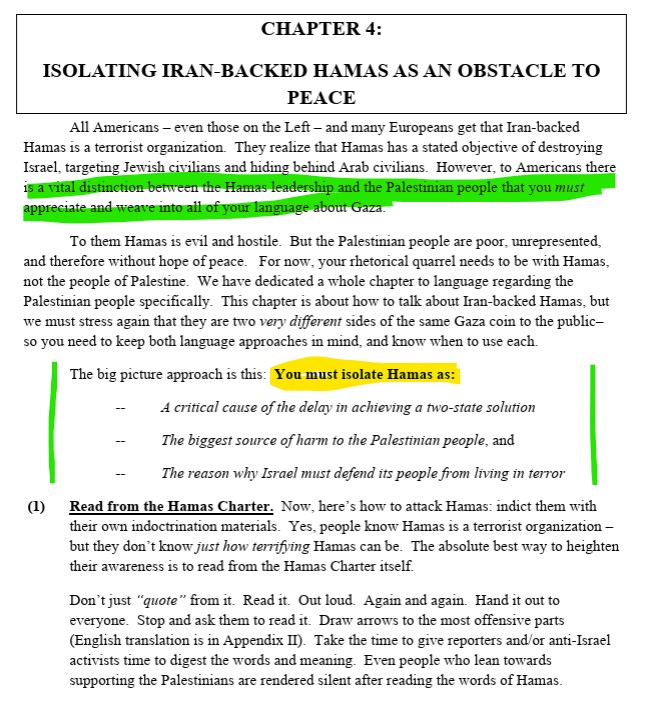
Source: The Israel Project – Global Language Dictionary (2009), Chapter 4.
Source: The Israel Project – Global Language Dictionary (2009), Chapter 4.
DESIGN, DIALOGUE AND THE INFORMATION WAR
The conflict surrounding Gaza is not only fought on the ground, but also through competing narratives. Media systems, political interests and cultural perspectives all shape how events are interpreted around the world.
Between Western and Muslim perspectives, the debate is often marked by polarization. Understanding how narratives are constructed — and why they resonate with different audiences — is therefore essential for any meaningful discussion of the conflict.
Design, communication and independent media can play a role in creating spaces where complex issues are explored rather than reduced to simple slogans. In an era increasingly defined by information wars, encouraging critical thinking and dialogue becomes more important than ever.