




Fashion photography is about much more than taking pictures of clothes. Behind a finished image is often a process involving concept development, planning, models, styling, location, photography and coordination between people with different creative roles.
For me, photography is closely connected to my background in visual design, graphic work and later fashion design. That interest began before ZLCOPENHAGEN and developed further through photoshoots and collaborations with photographers, models and other creative professionals.
THE LADY & THE WINDOW CLEANER – FROM CONCEPT TO PHOTOSHOOT
One example is The Lady & The Window Cleaner, a ZLCOPENHAGEN fashion photography project from 2013, shot in Magstræde in central Copenhagen. It began as a creative concept, but bringing the idea to life also required planning, coordination and a clear understanding of the practical constraints surrounding the production.
I was involved in the concept, coordination and key creative decisions together with the photographer and others involved in bringing the production together. We had a tight time frame and had selected a very specific part of Magstræde as our location.
Working in a public street created challenges that would not exist in a controlled studio. Cyclists and pedestrians continued to pass through the location while we were shooting, so parts of the production had to be coordinated around very short opportunities to capture the images. At times this created pressure and some frustration, but the team had to adapt and keep the production moving.
In the end, the photoshoot came together successfully and the team was pleased with the result. For me, the project also became an early example of something I have carried into later work: a creative idea only becomes a finished result when people, time, location and practical constraints can be brought together.
BEHIND THE SCENES – A FASHION PHOTOGRAPHY TEAM
The Lady & The Window Cleaner was created through collaboration between people with different creative and production roles. In front of the camera were models Patrick Eiermann and Rannvá Joensen, photographed by Bjarni Lamhauge of LAMB Productions.
The production also included Kaan Arici as videographer, Ricco Højland Hansen as editor, Ann Leivsgard Henriksen as makeup artist and Tom Krag as set assistant. Each person had a specific role, but the final result depended on those different contributions working together.
MODEL PHOTOGRAPHY ON LOCATION
Model photography on location is very different from working in a controlled studio. Magstræde gave the project a distinctive Copenhagen setting, with its historic buildings and narrow street forming part of the visual expression. At the same time, the location meant that the production had to adapt continuously to the activity around us.
The models, photographer and production team needed to be ready when an opportunity appeared to capture a particular shot. Communication and coordination therefore became just as important as the creative idea itself.
BEHIND THE SCENES OF THE PHOTOSHOOT
The process was also documented on video, providing a behind-the-scenes view of the photoshoot. It shows how models, photographer and production team work together to transform an idea into a finished fashion image – and how much activity can take place behind a photograph that may ultimately appear effortless.
DIFFERENT PHOTOGRAPHERS – DIFFERENT VISUAL EXPRESSIONS
Every photographer brings a different perspective to fashion photography. Some work primarily with location and storytelling, while others place greater emphasis on light, the body, form and a more stylised visual expression.
For ZLCOPENHAGEN, working with different photographers has also been a way of seeing the designs from new perspectives. The photographer’s choice of model, lighting and composition can change how the same product is perceived and give it a distinct visual identity.
ANDRES MOCA – LIGHT, BODY AND AESTHETICS
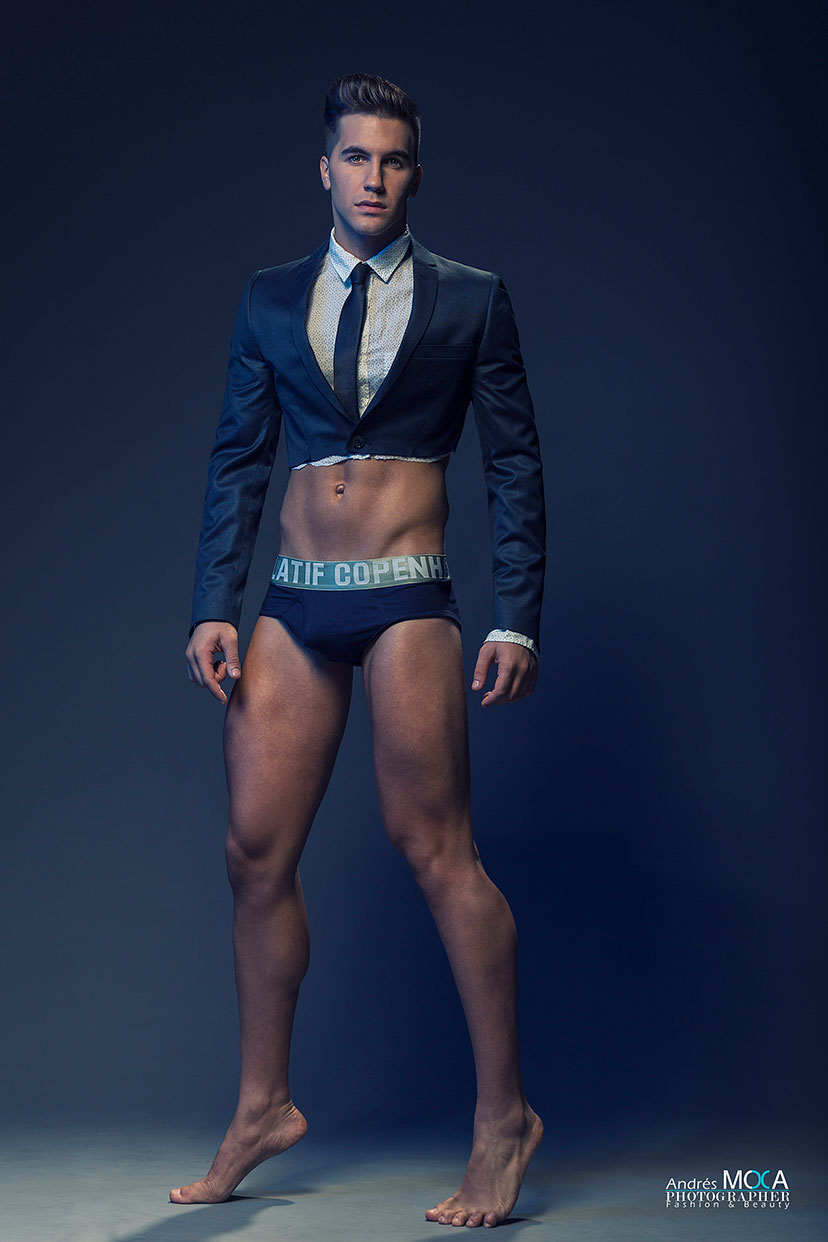
One example is photographer Andres Moca from Mérida, Spain, whose work has a strong focus on the male body, light and aesthetics. In our collaboration, ZLCOPENHAGEN men’s underwear formed part of the styling, with the photography highlighting the model, the shape of the body and the visual expression of the design.
Andres describes his approach to photography:
“I have always been fascinated by fashion photography, but male physique photography holds a special place for me. A man’s body can convey greater depth and strength in an image.”
His approach illustrates how lighting and photographic style can shape the story around both model and design. While a location-based project such as The Lady & The Window Cleaner is driven by setting, narrative and production, this type of fashion photography places greater emphasis on body, form and aesthetics.
THE MODEL AS PART OF THE FASHION IMAGE
In model photography, the model is not simply the person wearing the product. Posture, movement, expression and the ability to respond to the photographer’s direction all contribute to the final image.
This becomes particularly visible when photographing men’s underwear. With fewer elements in the styling, the relationship between the model, body, lighting and product design becomes more prominent. In several ZLCOPENHAGEN photoshoots, our own underwear has formed part of this visual storytelling.
FROM MODEL TO FINISHED FASHION IMAGE
These projects demonstrate that there is no single way to create a fashion image. A location-based photoshoot such as The Lady & The Window Cleaner can be shaped by narrative, surroundings and a larger production team, while other shoots may focus more directly on the model, lighting, body and product.
What they share is collaboration between people with different roles and skills. It is the interaction between concept, design, model, photography and production that transforms a product into a visual story.
INTERESTED IN BECOMING A MODEL?
If you are considering working as a model – including male underwear modelling – you can read our guide on how to become a model, where we look at some of the practical steps involved in getting started.

