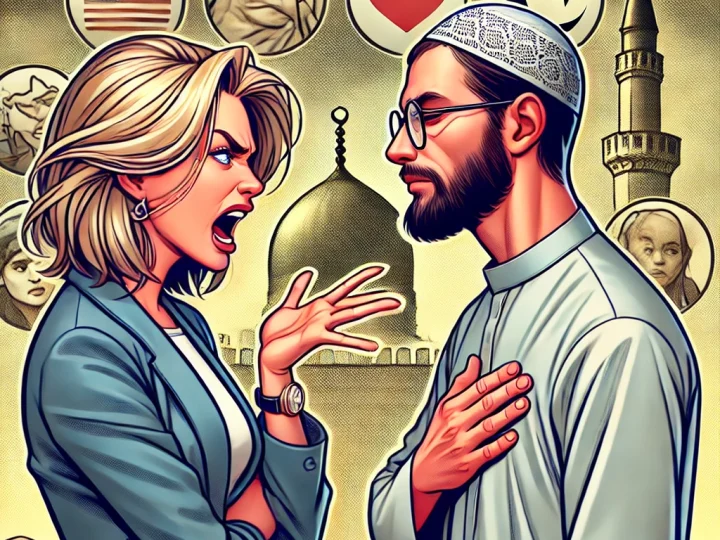
In modern political debates, language is rarely neutral. Words, images and narratives shape how societies understand identity, freedom and threat. In Denmark, discussions about Islam, integration and free speech have increasingly become arenas where these narratives collide. Also see the raising of racism here
This article examines the rhetoric of Alexander Küster, a local chairman of the Danish Social Democratic Party in Aarhus. Through an analysis of his statements and public interventions, the article explores how ideas about freedom, security and Western values are framed in relation to Muslims and minority groups.
Rather than focusing on isolated quotes, the analysis places Küster’s rhetoric within a broader political context. Similar patterns appear across Danish political discourse, where debates about Islam and national identity are often framed through moral contrasts between “us” and “them”.
By examining these rhetorical structures, the article aims to understand how political language shapes public perception, influences democratic debate and affects the position of minority communities in European societies.
“I do not know what choice others would make, but if forced to choose between extreme scenarios, one might prefer a quick end rather than a slow humiliation. A brutal comparison – yet such images are often used in political rhetoric to provoke fear rather than understanding.
Fortunately, these remain hypothetical scenarios. We live in a country that prides itself on freedom. Denmark is often portrayed as a beacon of liberty – a lantern in the darkness. But a lantern provides little guidance if people are expected to look away or remain silent.”
When rhetoric becomes extreme and fear is used as a weapon in public debate, a fundamental question emerges: what does freedom actually mean when it exists mainly as a contrast to the imagined threat of “the other”?
Alexander Küster is no stranger to dramatic comparisons and hypothetical scenarios. His choice of language has sparked questions about how political rhetoric shapes public perception, particularly when discussions about Islam, identity and Western values are framed through images of violence or cultural collapse.
This report examines Küster’s rhetorical strategies and explores how powerful imagery — such as references to beheading, hanging or humiliation — can be used to construct an “us versus them” narrative. In this framework, the West is positioned as the moral beacon of freedom, while opposing groups are portrayed primarily as existential threats.
But is the concept of freedom really that simple? And who ultimately controls the narrative when fear becomes the central tool of persuasion?
Fear-based rhetoric is a well-known technique in political communication. Rather than encouraging understanding, it appeals to anxiety and uncertainty in order to mobilize support or reinforce existing identities.
Recognizing these techniques is essential for maintaining a healthy democratic debate. When citizens become aware of how narratives are constructed, they are better equipped to question them, challenge them and resist manipulation.

I tillæg til mit spørgsmål om Danmarks pligt til at følge ICC’s arrestordre har jeg spurgt, om justitsministeren vil “afvise og fordømme” nedenstående udtalelse fra Alexander Küster, Socialdemokratiet lokalformand i Århus. Jeg forstår slet ikke, hvordan sådan en ekstremist kan… pic.twitter.com/CCm29YPQVY
— Zenia Stampe (@zeniastampe) November 21, 2024